
Diwali Sweet Safety: Why Sweet Manufacturers Should Test Their Products Before the Festive Season
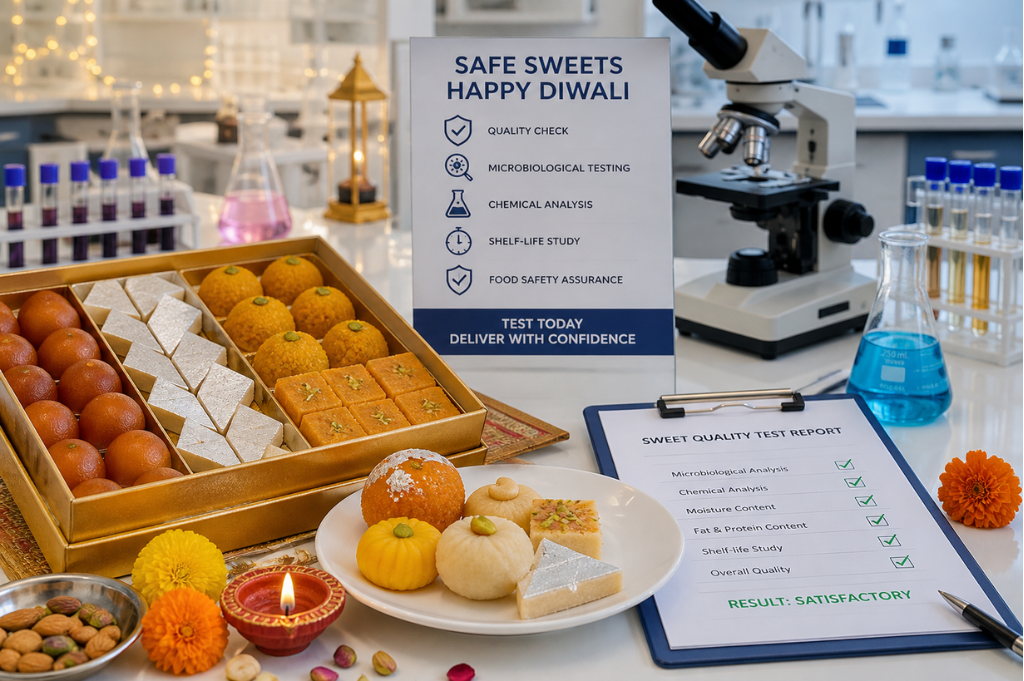
Diwali Sweet Safety: Why Sweet Manufacturers Should Test Their Products Before the Festive Season Diwali is one of India’s busiest seasons for sweet manufacturers. From laddus and Mysore pak to kaju katli, milk sweets, and packaged gift boxes, production increases as businesses prepare to meet festive demand. But with increased production comes an important responsibility: maintaining food quality and safety. For sweet manufacturers, food testing before Diwali can help assess product quality, identify potential safety concerns, and support compliance with applicable food safety requirements. Why Is Sweet Testing Important Before Diwali? During the festive season, manufacturers may increase production, handle larger quantities of ingredients, and distribute sweets to more retailers and customers. Appropriate laboratory testing can help businesses: Assess the quality of selected ingredients and finished products. Evaluate relevant microbiological risks. Check applicable chemical and composition parameters. Support shelf-life validation for packaged sweets. Maintain consistent quality during increased production. Prepare documentation relevant to applicable regulatory or customer requirements. Is a Laboratory Test Report Mandatory for Every Sweet? Not every sweet product automatically requires the same laboratory test report. Requirements depend on applicable FSSAI regulations, the product category, the nature of the business, and any specific regulatory or customer requirements. Sweet manufacturers should verify which testing and documentation requirements apply to their products and operations before the festive season. Even where a particular test report is not universally mandatory, appropriate testing can be an important part of a food safety and quality-control programme. Which Tests Should Sweet Manufacturers Consider Before Diwali? Depending on the product and applicable standards, manufacturers may need to consider: Microbiological testingTo assess relevant microbial risks and hygienic quality. Chemical and composition testingTo evaluate selected product parameters and verify applicable specifications. Shelf-life assessmentTo establish how the product performs under defined storage conditions. Nutritional analysisTo support applicable nutritional labelling requirements for packaged products. Contaminant or adulteration testingWhere relevant to the ingredients, product risks, and regulatory requirements. The right test plan depends on whether you manufacture milk-based sweets, dry sweets, nut-based sweets, or packaged festive gift products. Prepare Your Sweets for Diwali with ATL Labs This Diwali, don’t leave product quality to guesswork. Plan your testing requirements before production and distribution increase. ATL – Analytical Technology Laboratory supports businesses with food testing services. Contact our team to discuss suitable testing parameters and sample submission requirements for your products. ATL – Analytical Technology Laboratory Phone: +91 95008 95001 | Email: enquiry@atlabs.co.in Before your sweets reach customers, make quality a priority. Test with Precision.
What Tests Are Required for Indian Sweets? A Guide for Manufacturers

What Tests Are Required for Indian Sweets? A Guide for Manufacturers Indian sweets are an important part of festivals, celebrations, and everyday food culture. From laddus and Mysore pak to kaju katli, peda, and rasgulla, every sweet has its own ingredients, preparation methods, and storage requirements. But how can manufacturers ensure that their sweets meet the expected quality and food safety standards? Laboratory testing of Indian sweets helps manufacturers evaluate product quality, identify potential safety concerns, and make informed decisions about production, storage, and distribution. For businesses looking for a reliable sweet testing laboratory in Tamil Nadu, understanding the different types of food tests is an important first step. Why Is Laboratory Testing Important for Indian Sweets? Indian sweets may contain milk, ghee, sugar, nuts, flour, and other ingredients. Depending on their composition, moisture content, handling, and storage conditions, they may be susceptible to quality changes or microbial contamination. Laboratory testing can help manufacturers: Evaluate product composition and selected quality parameters. Identify relevant microbiological risks. Assess product stability and shelf life. Verify the quality of ingredients and finished products. Support compliance with applicable food safety requirements. Maintain consistent product quality across production batches. The appropriate tests depend on the type of sweet, its ingredients, manufacturing process, packaging, and intended shelf life. What Tests Are Required for Indian Sweets? There is no single testing package that applies to every Indian sweet. Manufacturers should select tests according to the product and applicable regulatory requirements. 1. Chemical and Composition Testing Chemical and composition testing helps evaluate selected characteristics of sweets and verify whether they meet the relevant product specifications. Depending on the product, testing may include: Moisture content Fat content Protein content Total ash Sugar or carbohydrate-related parameters Acidity and other relevant chemical parameters Permitted additives, preservatives, or contaminants, where applicable For example, milk-based sweets and ghee-rich products may require different testing parameters from sugar-based sweets or flour-based products. These analyses can help manufacturers understand product composition and investigate variations between batches. 2. Microbiological Testing of Sweets Microbiological testing is important for assessing the hygienic quality and potential microbial risks associated with food products. Depending on the type of sweet and its risk profile, relevant tests may include: Total plate count or aerobic microbial count Yeast and mould count Coliform testing Specific foodborne pathogens, where relevant Milk-based sweets, sweets with high moisture content, and products handled after cooking may require particular attention to hygiene, handling, and storage. Testing requirements should be selected according to the applicable food standards, product category, and intended use. A laboratory test alone does not replace good manufacturing practices or appropriate sanitation controls. 3. Shelf-Life Testing for Indian Sweets How long can a sweet remain suitable for consumption under its intended storage conditions? Shelf-life assessment helps manufacturers establish a scientifically supported period during which a product maintains its relevant quality and safety characteristics. A suitable assessment may consider: Changes in moisture and product texture Colour, flavour, and odour changes Microbiological quality over time Packaging performance Storage temperature and humidity Product-specific chemical or physical changes For example, a fresh milk-based sweet may behave differently during storage from a dry sweet with lower moisture content. Manufacturers should determine shelf life using appropriate studies under defined storage conditions rather than relying only on appearance or assumptions. 4. Food Adulteration and Contaminant Testing Ingredient quality is an important part of finished-product quality. Depending on the ingredients and potential risks, manufacturers may need testing to investigate adulteration or contaminants. Examples include: Verification of selected ingredient quality parameters Testing for relevant contaminants Investigation of suspected adulteration Testing for applicable residues or other regulated substances The appropriate analytical method depends on the suspected issue, ingredient, and relevant regulatory requirements. Not every sweet requires every contaminant test. Testing should be based on product composition, risk assessment, and applicable standards. 5. Nutritional Analysis and Labelling Support For packaged sweets, manufacturers may need nutritional information to support applicable labelling requirements. Depending on the product and regulatory requirements, nutritional analysis may cover parameters such as: Energy Protein Total fat Saturated fat Carbohydrates Total sugars Other applicable nutritional parameters Accurate nutritional information can support product development, labelling decisions, and communication with buyers. Manufacturers should confirm the applicable FSSAI labelling requirements for their specific products. Which Indian Sweets May Require Laboratory Testing? Different sweets have different testing needs. Milk-based sweets: Peda, rasgulla, rasmalai, milk cake, and similar products may require attention to microbiological quality, composition, and storage stability. Ghee-rich and flour-based sweets: Mysore pak, laddus, and related products may benefit from selected composition tests and assessments of quality changes during storage. Nut-based sweets: Kaju katli and other nut-based products may require suitable ingredient-quality and contaminant assessments, depending on the product and risks. Packaged sweets: Products distributed through retail outlets or across different locations may need testing that supports product specifications, applicable labelling requirements, and shelf-life validation. The exact test plan should be established for each product rather than applying the same list to every sweet. How to Choose a Sweet Testing Laboratory in Tamil Nadu Selecting the right laboratory is an important step for sweet manufacturers and food businesses. Before submitting samples, consider the following: Relevant testing scope: Check whether the laboratory’s current accreditation and approval scope covers the required tests and product matrix. Suitable analytical methods: Confirm that the methods used are appropriate for the sweet being tested. Regulatory requirements: Identify the applicable FSSAI standards and testing requirements for your product. Sample requirements: Ask about sample quantity, packaging, transport, and storage conditions. Reporting timelines: Confirm the expected turnaround time before submitting samples. Clear reporting: Ensure that the report identifies the tests performed, results, and applicable specifications where relevant. A laboratory’s accreditation or approval should be verified against its current scope. Not every accredited laboratory is authorized for every test or product category. How ATL Labs Supports Food Testing Requirements ATL – Analytical Technology Laboratory provides food testing services for businesses that need analytical support for product quality and safety. Sweet manufacturers can contact ATL Labs to discuss their products, intended
Food Testing Labs in Coimbatore: How to Choose the Right Laboratory

Food Testing Labs in Coimbatore: How to Choose the Right Laboratory Choosing the right food testing lab in Coimbatore is an important step for businesses that want to maintain food quality, evaluate product safety and meet applicable regulatory requirements. Whether you manufacture packaged foods, operate a bakery, process dairy products or supply food for export, laboratory testing can help you make informed quality-control decisions. However, not every laboratory offers the same testing parameters, methods or accreditation scope. Before submitting your samples, it is important to understand your testing requirements and select a laboratory that can meet them. In this guide, we explain what to look for when choosing a food testing laboratory in Coimbatore, the types of food tests available and how businesses can prepare samples for analysis. Why Is Food Testing Important for Businesses? Food products may require testing at different stages, from raw-material inspection to finished-product verification. The appropriate tests depend on the product, manufacturing process, intended use and applicable standards. Working with a suitable food testing laboratory can help businesses: Evaluate food quality and product consistency. Assess relevant microbiological and chemical parameters. Verify nutritional information for food-labeling purposes. Investigate potential contamination concerns. Support quality-control procedures and applicable compliance requirements. Maintain documented test results for internal review and customer requirements. Food testing does not replace good manufacturing practices, hygiene controls or regulatory responsibilities. Instead, it provides analytical information that supports these activities. What Services Should a Food Testing Lab in Coimbatore Offer? Before selecting a laboratory, identify the tests required for your specific food product. Common testing categories include the following. 1. Food Quality Testing Food quality testing helps evaluate characteristics that matter to manufacturers, processors and buyers. Depending on the product, testing may include moisture, acidity, composition and other relevant quality parameters. For example, rice processors may need moisture and quality-related analysis, while manufacturers of packaged snacks may require product-specific composition testing. 2. Microbiological Food Testing Microbiological testing evaluates selected microorganisms in food samples using appropriate laboratory methods. Depending on the food category and applicable requirements, testing may include indicators of hygiene and specific foodborne microorganisms. The parameters selected should reflect the product, risk assessment and relevant standards. 3. Nutritional Testing Nutritional analysis helps food businesses determine selected nutritional values for product development and labeling purposes. Depending on the product and intended labeling requirements, relevant parameters may include: Protein Fat Carbohydrates Energy value Moisture Ash Other applicable nutritional components Businesses should confirm the required nutritional panel and calculation or reporting approach with their laboratory before submitting samples. 4. Chemical and Contaminant Testing Some food products require analysis for chemical contaminants or other product-specific risks. The appropriate tests depend on ingredients, sourcing, processing and intended market. Possible areas of analysis include selected heavy metals, pesticide residues, mycotoxins, additives or other contaminants where relevant. Not every parameter applies to every food product. A laboratory can help identify suitable tests based on your requirements and the methods available within its scope. 5. Product-Specific Food Testing Different products need different testing approaches. For example: Milk and dairy products: relevant composition, quality and microbiological parameters. Sweets and confectionery: product quality, composition and applicable safety parameters. Rice and food grains: moisture, quality and relevant contaminant parameters. Cookies and bakery products: nutritional analysis, moisture and other applicable quality or safety tests. Seafood: relevant microbiological, contaminant and residue analysis based on the product and market requirements. Choosing product-specific testing helps businesses avoid ordering unsuitable test panels. How to Choose the Right Food Testing Laboratory When comparing food testing labs in Coimbatore, consider these five important factors. 1. Check Accreditation and Approval Scope Accreditation and regulatory approval are important considerations, but the laboratory’s status alone is not enough. Check whether the relevant tests are included in its current scope. For example, if your business needs nutritional analysis, microbiological testing or contaminant analysis, verify the applicable methods and parameters rather than assuming that every service is covered by a general accreditation. Where relevant, confirm the laboratory’s current NABL accreditation and applicable FSSAI recognition or approval using official records. 2. Confirm the Required Testing Parameters Explain your product type and the purpose of testing before requesting a quotation. A laboratory should be able to clarify which parameters are available, which method is appropriate and whether the requested tests meet your intended requirements. This is particularly important when testing for regulatory compliance, export specifications or customer-defined standards. 3. Ask About Sample Requirements Correct sample collection and handling help reduce the risk of unsuitable or compromised samples. Before submission, confirm: The quantity required for each test. The appropriate container and packaging. Any storage or transportation conditions. Sample identification and labeling instructions. Whether separate samples are needed for different tests. Follow the laboratory’s instructions, especially for perishable food and microbiological samples. 4. Understand Turnaround Time and Reporting Ask for the expected turnaround time for your selected test parameters. Timelines may vary depending on the methods, number of tests, sample condition and need for additional analysis. You should also understand what the report contains, including test methods where applicable, results, units, relevant reporting limits and any applicable specifications. If the results will be used for regulatory or customer acceptance, confirm that the report format and testing scope meet those requirements. 5. Compare Quotations Carefully The lowest quotation is not always the best choice. Compare laboratories based on the required parameters, methods, applicable accreditation scope, reporting requirements, turnaround time and technical support. Request an itemized quotation so you can understand which tests are included and whether any additional charges may apply. What Is the Food Sample Testing Process? Although procedures vary by laboratory and test type, the general process often follows these steps. Step 1: Discuss your requirements. Explain the product, intended use and reason for testing. Step 2: Select the parameters. Confirm the appropriate test panel and available methods. Step 3: Prepare and submit the sample. Follow the laboratory’s instructions for collection, quantity, packaging and transportation. Step 4: Laboratory analysis. The laboratory performs the agreed tests using applicable methods. Step 5:
Cookies Testing for Food Businesses: From Small Bakeries to Large Manufacturers

Cookies Testing for Food Businesses: From Small Bakeries to Large Manufacturers Cookies are enjoyed across India, from freshly baked products sold by local bakeries to packaged cookies distributed by large food manufacturers. But behind every consistent, safe and market-ready cookie is an important quality-control process: laboratory testing. For bakeries, food brands and manufacturers, cookie testing can help evaluate product quality, nutritional composition, microbiological safety and other relevant parameters. Working with a reliable cookies testing laboratory in Tamil Nadu can help businesses make informed decisions about their products and support applicable food-safety and labelling requirements. Whether you operate a small bakery in Coimbatore or manufacture cookies for wider distribution, testing can be an important part of maintaining product consistency and consumer confidence. Why Is Cookie Testing Important for Food Businesses? Cookie quality can be affected by ingredients, processing conditions, storage, packaging and shelf-life conditions. Even a small change in formulation or processing may influence the final product. A structured testing programme can help businesses: Evaluate the quality and safety of finished cookies Check nutritional composition Support accurate nutrition information on labels Identify potential microbiological concerns Monitor consistency between production batches Evaluate products during formulation and process development Support quality-control documentation Investigate quality issues or customer complaints Generate laboratory reports for business and regulatory requirements FSSAI identifies food testing as an important part of the food-safety system and maintains information on recognized/notified food laboratories, including NABL-accredited laboratories recognized for food analysis. Who Needs Cookie Testing? Cookie testing is not limited to large food manufacturers. Businesses at different stages of production can benefit from appropriate laboratory analysis. Small Bakeries Small bakeries may produce cookies in multiple varieties, including: Butter cookies Chocolate cookies Coconut cookies Oat cookies Millet cookies Cream-filled cookies Nut-based cookies Sugar-free or reduced-sugar variants Testing can help a bakery understand the quality and composition of its products before expanding production or introducing new products. Growing Food Brands For emerging brands, testing becomes increasingly important when moving from small-batch production to packaged products. Laboratory analysis can help businesses evaluate a formulation, establish product specifications and support nutrition information used for packaging. Large Cookie Manufacturers Large-scale manufacturers generally need stronger quality-control systems because production involves higher volumes, multiple batches, raw-material suppliers and wider distribution. Regular testing can help manufacturers monitor finished-product quality and investigate variations between batches. What Tests Are Commonly Performed for Cookies? The exact testing requirements depend on the product formulation, ingredients, intended claims, applicable standards and the purpose of the analysis. A cookies testing laboratory in Tamil Nadu may evaluate different categories of parameters based on the testing requirement. 1. Nutritional Testing for Cookies Nutritional Testing for Cookies helps determine the nutritional composition of the product. Depending on the product and requirement, analysis may include parameters such as: Protein Total fat Carbohydrates Energy value Dietary fibre Sugars Moisture Ash Sodium and other relevant nutritional parameters Nutritional analysis can be particularly useful when preparing or reviewing nutrition information for packaged food products. 2. Microbiological Testing Microbiological analysis can help assess the microbiological quality of cookies. Depending on the product and applicable testing requirements, parameters may include relevant microbial indicators or pathogens. This type of testing becomes especially important when manufacturers are evaluating product hygiene, process controls, storage conditions or shelf life. 3. Chemical and Quality Analysis Chemical and physicochemical testing can help evaluate characteristics that influence product quality and consistency. Depending on the cookie formulation, testing may cover parameters related to: Moisture Fat Acidity Ash Other product-specific characteristics The appropriate test panel should be selected based on the cookie type, ingredients and intended purpose of the analysis. 4. Ingredient-Related Testing Cookies may contain ingredients such as flour, fats and oils, milk ingredients, cocoa, nuts, eggs, spices, sweeteners and other components. When required, businesses may also test raw materials or investigate specific quality concerns associated with ingredients. 5. Shelf-Life Related Testing Shelf life is an important consideration for packaged cookies. Testing can support shelf-life studies by helping businesses monitor selected quality and safety parameters over defined storage periods. A suitable shelf-life study should consider the formulation, packaging, storage conditions and intended distribution environment rather than relying on a single test result. FSSAI Testing for Cookies: What Businesses Should Know FSSAI testing for cookies should be considered in the context of the applicable food category, formulation, standards, labelling requirements and testing purpose. FSSAI’s published standards include biscuits and cookies within the bakery-products framework, and its food-testing resources provide methods and standards applicable to different food categories. Food businesses should avoid assuming that one universal test package applies to every cookie. A chocolate-filled cookie, a millet cookie, a high-fibre cookie and a plain butter cookie may have different testing considerations because their formulations and claims can differ. For regulatory or compliance-related testing, businesses should confirm the current applicable requirements and select an appropriately recognized laboratory and relevant test scope. Why Choose a Food Testing Laboratory in Coimbatore? For businesses operating in Coimbatore and surrounding industrial areas, working with a food testing laboratory in Coimbatore can make sample submission, communication and testing coordination more convenient. Local laboratory support can be useful for: Bakeries Food manufacturers Private-label food brands Export-oriented businesses Product-development teams Quality-control departments Food ingredient suppliers Choosing a laboratory should not be based only on location. Businesses should also consider the laboratory’s accreditation or recognition status, relevant testing scope, analytical capabilities, reporting process and experience with the required food category. How Does Cookie Testing Work? The testing process generally involves several stages. Step 1: Define the Testing Requirement First, identify why the sample needs to be tested. For example: New product development Nutrition labelling Routine quality control Shelf-life study Regulatory requirement Customer requirement Complaint investigation Step 2: Select the Appropriate Test Parameters The laboratory can help identify suitable parameters based on the sample and testing objective. Step 3: Submit the Cookie Sample The sample should be collected, packed and submitted according to the laboratory’s sample requirements to help maintain its integrity. Step 4: Laboratory Analysis The sample is analysed using applicable methods and
Top 10 Food Testing Labs in India for Manufacturers, Exporters & Food Brands

Top 10 Food Testing Labs in India for Manufacturers, Exporters & Food Brands Choosing the right food testing laboratory is an important step for food manufacturers, exporters, startups, retailers, and established food brands. Laboratory testing can help businesses evaluate food quality, safety, nutritional composition, contaminants, microbiological parameters, and other product-specific requirements. India has a large network of food laboratories. FSSAI states that it recognizes and notifies food laboratories, including NABL-accredited laboratories, under Section 43 of the Food Safety and Standards Act. Its food-laboratory page currently provides a primary food laboratory list dated 7 September 2026. This guide highlights 10 food testing laboratories in India that manufacturers, exporters, and food brands can consider based on their documented food-testing capabilities, accreditation/recognition information, and service coverage. The list is an informational shortlist, not an official ranking by FSSAI or NABL. Testing scope and accreditation can vary by location and parameter, so businesses should verify the current scope before submitting samples. What Does a Food Testing Laboratory Do? A food testing laboratory scientifically analyses food samples to determine whether they meet defined quality, safety, nutritional, and regulatory requirements. Depending on the product, testing may include: Nutritional analysis Microbiological testing Chemical analysis Pesticide residue testing Mycotoxin testing Heavy metal analysis Food adulteration testing Allergen testing Shelf-life studies Food additive and preservative testing Residue and contaminant analysis Packaging-related testing Species identification and authenticity testing For food exporters and manufacturers, the required testing depends on the product, destination market, applicable regulations, customer specifications, and the laboratory’s accredited scope. Top 10 Food Testing Labs in India 1. ATL Labs – Analytical Technology Laboratory, Coimbatore ATL Labs is a testing laboratory based in Coimbatore, Tamil Nadu, providing food and agriculture testing along with water, environmental, textile, marine and aquaculture testing. ATL’s food-testing services cover physical and chemical parameters, microbiological testing, nutritional analysis, shelf-life testing, allergen testing, meat species identification, and food packaging-related analysis. Its food and agriculture scope includes products such as cereals, pulses, bakery products, beverages, edible oils, dairy products, seafood, spices, snacks, sugar products and more. ATL states that its food-testing laboratory is accredited to ISO/IEC 17025:2017 by NABL and recognized/approved by organizations including FSSAI, APEDA, EIC and the Tea Board for relevant testing activities. Food testing services include: Nutritional analysis Microbiological testing Chemical testing Pesticide and contaminant analysis Food safety testing Shelf-life testing Allergen testing Food and agricultural product testing For businesses in Tamil Nadu looking for a food testing laboratory, ATL provides a broad testing portfolio from its Coimbatore facility. 2. Eurofins India Eurofins India Food Testing provides food and feed testing services across a broad range of food categories. Its documented services include nutritional analysis, allergen testing, authenticity testing, GMO analysis, residues and contaminants, pesticides, mycotoxins, food fraud analysis and other analytical services. Eurofins states that its network includes more than 300 food and feed testing laboratories globally. Suitable for: Food manufacturers International food brands Exporters Ingredient suppliers Nutritional labelling Food authenticity projects 3. SGS India SGS India Food Testing offers food safety, quality and sustainability testing services. Its food-testing portfolio includes allergens, contaminants, integrity and authenticity, microbiology, nutritional and composition analysis. SGS also provides food pathogen testing and physical testing services. Testing areas include: Food microbiology Pathogen testing Nutritional analysis Food contaminants Food authenticity Physical testing Food safety testing SGS also highlights services designed to support businesses supplying food products to international markets. 4. Intertek India Intertek India Food Testing provides food testing and analysis services for manufacturers and food businesses. Intertek’s India food-testing portfolio includes processed foods, beverages, agricultural products, food additives, packaging, marine products, meat, fruits and vegetables. Its listed services include allergen, chemical, nutritional, microbiological, residue, contaminant, shelf-life, GMO, seafood and nutritional labelling analysis. Useful testing areas: Nutritional testing Microbiology Allergen testing Shelf-life testing Food residues Contaminants Seafood testing Food packaging testing Intertek lists food laboratory locations in Gurgaon and Hyderabad. 5. Vimta Labs Vimta Labs Food Testing provides food and agriculture testing services across multiple laboratory locations in India. Vimta states that its food-testing services cover product categories such as water and beverages, bakery and confectionery, ready-to-eat foods, condiments, additives, proprietary foods, nutraceuticals, herbals and dietary supplements. It also describes its laboratories as NABL accredited and notes FSSAI National Reference Laboratory recognition for water and beverages. Testing areas include: Food safety Nutritional analysis Pesticide residues Heavy metals Food and beverage testing Dairy testing Nutraceutical testing 6. FARE Labs FARE Labs provides food and agricultural product testing for domestic and export requirements. FARE Labs states that its food-testing services are recognized by FSSAI, APEDA, EIC and BIS and cover physical, chemical, biological and radiological testing. Its food-testing portfolio includes nutritional analysis, composition, adulteration, mycotoxins, residues and elemental testing. Suitable for: Food manufacturers Agricultural product businesses Exporters Processed food companies Nutritional labelling Food safety programmes FARE Labs also states that it supports export consignments according to applicable customer and regulatory requirements. 7. Bureau Veritas India Bureau Veritas India Food Services provides testing, inspection and certification services for food manufacturing and processing. Its food services include laboratory testing for ingredient quality and safety and testing support for international market access. Bureau Veritas also provides food traceability and supply-chain quality solutions. For food retailers and hospitality businesses, its services include laboratory testing related to safety, compliance and nutritional labelling. 8. Centre for Food Research and Analysis – NIFTEM The Centre for Food Research and Analysis (CFRA), NIFTEM is a specialized food-testing facility under the National Institute of Food Technology, Entrepreneurship and Management. CFRA describes itself as an accredited food testing laboratory and a Referral Laboratory of FSSAI. Its capabilities include nutritional profiling, microbiological testing, physico-chemical analysis, adulteration analysis, pesticides, heavy metals and mycotoxins. CFRA states that it serves entrepreneurs, food industries, exporters and other food-sector stakeholders and has an NABL ISO/IEC 17025:2017 accreditation for chemical and biological disciplines. 9. MicroChem Silliker MicroChem Silliker is a food-testing laboratory based in Navi Mumbai with documented capabilities across multiple food categories. Government and standards-related records show its involvement in testing products such as cereals, dairy
Oil Quality Testing in India: A Complete Guide to Laboratory Testing
Oil Quality Testing in India: A Complete Guide to Laboratory Testing Oil products are used across many industries, including manufacturing, automotive, engineering, energy, and industrial operations. Their quality can directly affect equipment performance, product consistency, safety, and operational efficiency. Oil quality testing in India helps businesses understand whether an oil product meets the required specifications and is suitable for its intended application. Laboratory analysis can identify important characteristics such as viscosity, density, flash point, water content, contamination, and other relevant parameters. For businesses that depend on petroleum products, lubricants, and industrial oils, laboratory testing provides reliable data for quality control and informed decision-making. What Is Oil Quality Testing? Oil quality testing is the laboratory analysis of an oil sample to determine its physical, chemical, and performance-related characteristics. Depending on the type and application of the oil, laboratories may examine different parameters. The selected tests should be based on the product specification, intended use, applicable standards, and customer requirements. Professional oil quality testing in India can help manufacturers, suppliers, industrial users, and other businesses verify product quality before use or delivery. Why Is Oil Quality Testing Important? Oil that does not meet the required specifications may affect equipment operation, product performance, or process consistency. Laboratory testing can help businesses: Verify the quality of incoming oil products Check whether products meet specified requirements Identify possible contamination Monitor changes in oil condition Support quality-control programs Investigate oil-related performance issues Maintain consistent product quality Generate documented laboratory test results Instead of relying only on appearance or basic physical checks, laboratory analysis provides measurable information about the sample. What Parameters Are Tested in Oil Products? The parameters selected for analysis depend on the type of oil and the purpose of testing. 1. Viscosity Viscosity indicates how easily an oil flows under specified conditions. It is an important property for many lubricants and industrial oils because it can influence lubrication and equipment operation. 2. Density Density helps characterize an oil product and can be useful for quality control and product identification. 3. Flash Point Flash point testing determines the temperature at which an oil sample produces vapour that can ignite under specified test conditions. This parameter is particularly relevant when evaluating the handling and safety characteristics of petroleum-based products. 4. Water Content Water contamination can affect the performance and condition of certain oils. Laboratory testing can help determine the presence or level of water in a sample. 5. Contamination and Impurities Testing may be used to identify unwanted contaminants or impurities that could affect oil quality or equipment performance. 6. Chemical and Performance Parameters Depending on the oil product, additional chemical or performance-related parameters may be tested according to applicable specifications and standards. Oil Testing Laboratory in Tamil Nadu: What Should Businesses Look For? Businesses searching for an oil testing laboratory in Tamil Nadu should consider factors beyond the availability of individual tests. Important considerations include: Relevant laboratory testing capabilities Appropriate testing methods Qualified technical personnel Suitable laboratory infrastructure Quality-management practices Applicable accreditation or recognition Clear test reports Sample handling and traceability Testing requirements relevant to the product The laboratory should also be able to explain which parameters are appropriate for the specific oil product and testing objective. Lubricant Testing Laboratory Services Lubricants are designed to reduce friction, protect components, and support reliable equipment operation. Their properties need to remain within appropriate specifications for their intended application. A lubricant testing laboratory may conduct tests based on the type of lubricant and the customer’s requirements. Testing may support: Incoming lubricant quality checks Product quality control Comparative analysis Investigation of performance issues Research and development Specification verification Condition monitoring The exact test package should always be selected according to the lubricant type, application, and applicable specification. Petroleum Product Testing in India Petroleum products can have different characteristics and testing requirements depending on their composition and intended application. Petroleum product testing in India can help businesses evaluate specified physical and chemical properties of products such as fuels, oils, and related petroleum-based materials. Laboratory testing may be used for: Quality control Product verification Specification compliance Troubleshooting Research and development Incoming and outgoing material checks The laboratory report provides documented analytical results that can support technical and quality-related decisions. How Does Laboratory Oil Testing Work? The testing process generally follows a structured sequence. Step 1: Sample Collection A representative sample is collected using appropriate sampling practices. Poor sampling can affect the reliability of the final result. Step 2: Sample Identification The sample is properly identified and documented before analysis. Step 3: Test Selection Testing parameters are selected according to the oil type, purpose of analysis, applicable specification, and customer requirements. Step 4: Laboratory Analysis The sample is analysed using appropriate laboratory methods and equipment. Step 5: Quality Review Test results undergo appropriate laboratory quality-control and review procedures. Step 6: Test Report The final report presents the tested parameters and corresponding analytical results. When Should Oil Products Be Tested? Oil testing can be useful at different stages of a product’s lifecycle. Businesses may consider testing: Before accepting incoming materials During manufacturing or processing Before dispatch During quality investigations When changing suppliers During product development When investigating equipment or process issues As part of a regular quality-control program The appropriate testing frequency depends on the product, application, risk, and quality requirements. How to Choose an Oil Testing Laboratory in India Choosing an appropriate laboratory is important when test results will be used for quality-control, technical, or compliance-related decisions. Before selecting a laboratory, consider: Testing scope – Check whether the laboratory offers the required oil or petroleum product tests. Relevant methods – Confirm that appropriate and recognized test methods are available. Laboratory competence – Review the laboratory’s quality systems and applicable accreditation. Sample requirements – Understand the quantity, container, and sampling requirements. Reporting – Check whether reports clearly identify methods, parameters, units, and results. Application expertise – Discuss your testing objective with the laboratory before submitting samples. Benefits of Professional Oil Quality Testing Laboratory testing can provide businesses with objective analytical data instead
Rice Testing in Tamil Nadu: Quality, Safety and Nutritional Parameters Explained
Rice Testing in Tamil Nadu: Quality, Safety and Nutritional Parameters Explained Rice is one of the most widely consumed food grains in India, making quality and safety testing important for rice manufacturers, processors, exporters, traders, retailers and food businesses. Laboratory testing helps identify quality variations, nutritional characteristics and potential contaminants before rice reaches consumers. A reliable rice testing laboratory in Tamil Nadu can evaluate important physical, chemical, nutritional and microbiological parameters to help businesses make informed quality-control decisions. In this guide, we explain the major parameters involved in rice testing, why laboratory analysis matters, and how testing supports food safety and regulatory compliance. What Is Rice Testing? Rice testing is the laboratory analysis of rice samples to determine their quality, safety, composition and nutritional characteristics. Depending on the purpose of testing, laboratories may examine parameters such as: Moisture content Protein Fat Carbohydrates Ash Energy value Physical characteristics Microbiological quality Contaminants Mycotoxins Pesticide residues Heavy metals The exact test panel depends on the type of rice, intended application, regulatory requirements and customer specifications. Why Is Rice Testing Important in Tamil Nadu? Rice can be affected by factors such as cultivation conditions, storage, transportation, processing and handling. Testing provides objective laboratory data that can help businesses verify the quality of their products. For rice businesses in Tamil Nadu, laboratory testing can support: Quality control during production Raw-material evaluation Supplier verification Food safety assessment Product development Regulatory compliance Export-quality verification Nutritional labelling requirements Shelf-life and storage decisions Instead of relying only on visual inspection, laboratory analysis provides measurable results for important quality and safety parameters. Key Parameters Tested in Rice 1. Moisture Content Moisture is an important quality parameter for stored rice. Excessive moisture can contribute to undesirable changes during storage and may increase the risk of microbial growth under suitable conditions. Moisture testing helps businesses monitor the condition of rice during processing and storage. 2. Nutritional Composition Nutritional analysis can provide information about the composition of rice, including: Protein Fat Carbohydrates Ash Dietary fibre, where applicable Energy This is part of Nutritional Testing of Food Grains, which can be useful for food manufacturers, processors and businesses preparing nutritional information for products. 3. Microbiological Testing Microbiological analysis helps evaluate the microbiological quality of rice and rice-based products. Depending on the sample and testing objective, laboratories may examine relevant microorganisms and indicators according to applicable standards or specifications. 4. Mycotoxin Testing Mycotoxins are naturally occurring toxic compounds that can be produced by certain fungi under favourable conditions. Mycotoxin Testing in Food Grains can therefore be an important component of food-safety testing, particularly when assessing grain quality and potential contamination. The specific mycotoxins tested should be selected according to the commodity, regulatory requirements and intended market. 5. Heavy Metal Testing Rice and other grains may require testing for specific heavy metals depending on the source, environment, regulatory requirements and intended application. Laboratory analysis can help determine whether the tested sample meets the applicable limits or customer specifications. 6. Pesticide Residue Testing Rice may also be analysed for pesticide residues when required by regulations, buyers, export markets or food-safety programs. A suitable pesticide residue testing panel should be selected based on the commodity and target market. Rice Quality Testing for Food Businesses Rice manufacturers and food businesses may require different testing programs depending on their operations. For example: Rice processors may focus on raw-material quality and process consistency. Food manufacturers may require nutritional, microbiological and contaminant testing. Exporters may require testing against destination-market requirements and customer specifications. Traders and procurement teams may use laboratory reports to support supplier and batch evaluation. This makes it important to choose a laboratory capable of providing the appropriate analytical scope rather than relying on a one-size-fits-all testing package. Rice Testing vs Wheat Testing Rice is not the only grain that requires quality and safety analysis. Wheat and other cereals also undergo laboratory testing for different quality parameters. A Wheat Testing Laboratory in Tamil Nadu may analyse parameters such as moisture, protein, ash, gluten-related characteristics and other applicable quality or safety parameters. The appropriate testing parameters vary according to the grain, product type and intended use. How Does a Rice Testing Laboratory Work? A typical laboratory testing process involves several stages: Step 1: Sample Collection A representative sample is collected according to the applicable sampling procedure. Step 2: Sample Receipt and Identification The laboratory records the sample details and assigns appropriate identification for traceability. Step 3: Sample Preparation The sample is prepared using the procedure appropriate to the requested analysis. Step 4: Laboratory Analysis Trained laboratory personnel conduct the required tests using validated or applicable analytical methods. Step 5: Quality Review Test results undergo appropriate laboratory quality-control procedures before reporting. Step 6: Test Report The final report presents the analytical results and relevant information associated with the testing performed. How to Choose a Rice Testing Laboratory in Tamil Nadu? Businesses should consider several factors before selecting a laboratory. Check Laboratory Accreditation Look for relevant accreditation, such as ISO/IEC 17025, for the required testing scope. Review the Testing Scope Make sure the laboratory offers the parameters your business actually needs, whether nutritional, microbiological, chemical or contaminant testing. Consider Industry Experience Experience with food grains and related food products can help laboratories understand different testing requirements. Ask About Sample Requirements Before sending samples, confirm the required sample quantity, packaging, storage and transportation conditions. Check Reporting Requirements For regulatory, export or customer purposes, confirm that the laboratory report contains the information required for your application. Why Choose ATL Labs for Food Grain Testing? ATL Labs provides analytical testing services for food and related products, supporting businesses that require reliable laboratory analysis. Testing requirements differ from one product and application to another. Therefore, businesses should discuss their specific requirements with the laboratory before selecting the final test panel. For rice, wheat, pulses and other food grains, the appropriate testing program can be designed around the product, intended market and applicable requirements. Frequently Asked Questions About Rice Testing What is tested in rice quality testing?
Small Food Business Ideas in India: From Homemade Products to Retail Brands

Small Food Business Ideas in India: From Homemade Products to Retail Brands Starting a food business does not always require a large factory, expensive machinery, or a huge investment. Across India, entrepreneurs are turning homemade recipes, traditional foods, snacks, beverages, and specialty products into small but growing food brands. If you are exploring small food business ideas in India, the opportunity can range from a home-based food operation to a packaged food brand selling through supermarkets, online marketplaces, and retail stores. However, creating a successful food product involves more than developing a good recipe. Food safety, nutritional information, shelf life, product quality, labeling, and regulatory requirements can become important as your business grows. This guide explains potential small food business ideas and why food testing can be an important part of moving from a homemade product to a retail-ready food brand. What Are Small Food Business Ideas in India? Small food business ideas in India include food ventures that can be started with relatively limited infrastructure and gradually expanded based on customer demand. Some common opportunities include: Homemade snacks and traditional sweets Spice and masala products Pickles and ready-to-eat foods Bakery and confectionery products Millet-based food products Health and wellness food products Ready-to-cook mixes Sauces, spreads, and chutneys Packaged beverages Regional and traditional food products The right opportunity depends on factors such as your target customers, production capacity, ingredients, investment, packaging, distribution model, and product positioning. 10 Small Food Business Ideas in India to Explore 1. Homemade Snacks Traditional snacks can be a practical starting point for a homemade food business in India. Products such as murukku, mixture, chips, cookies, and regional specialties can be sold locally or through online channels. As production increases, testing can help businesses understand product quality and suitability for wider distribution. 2. Pickles and Preserved Foods Pickles, sauces, chutneys, and other preserved foods can appeal to customers looking for convenient traditional products. For packaged products, businesses should consider factors such as microbiological quality, chemical parameters, packaging, and shelf life. 3. Millet-Based Food Products Millet-based products have created opportunities for entrepreneurs developing snacks, flour blends, ready-to-cook products, cookies, and other foods. Product development should consider nutritional composition and the information required for appropriate food labeling. 4. Spice and Masala Products Spice powders and blended masalas can be developed as niche or regional products. Consistency in ingredients and product quality is important when moving from small-batch production toward a larger retail operation. 5. Ready-to-Cook Food Products Ready-to-cook mixes can provide convenience for consumers while allowing small businesses to develop specialized products. Examples include dosa mixes, instant mixes, soup mixes, breakfast mixes, and regional food preparations. 6. Bakery and Confectionery Products Cookies, cakes, biscuits, brownies, and other bakery products can begin as home-based ventures and later develop into packaged brands. For packaged products, businesses may need to evaluate nutritional composition, microbiological quality, shelf life, and other relevant parameters. 7. Healthy and Functional Food Products Products positioned around nutrition, wellness, or specific dietary preferences require careful attention to their composition and claims. Nutritional analysis for food products can help determine values such as energy, protein, carbohydrate, fat, dietary fibre, and other applicable nutritional parameters. 8. Sauces, Spreads and Chutneys Sauces, spreads, dips, and chutneys can be developed as packaged food products for retail and online sales. Testing can help businesses evaluate product characteristics and quality before expanding distribution. 9. Traditional Regional Foods India’s regional food diversity provides opportunities to turn traditional recipes into modern packaged products. Entrepreneurs can build brands around regional snacks, specialty foods, traditional mixes, and other locally inspired products. 10. Packaged Food Products for Retail Once a product gains customers, the next step may be moving from direct local sales to supermarkets, distributors, e-commerce platforms, and other retail channels. At this stage, food testing and documentation become increasingly important for building a structured food business. Why Food Testing Matters for a Small Food Business A recipe that works well in a home kitchen may not automatically be ready for commercial distribution. As a food business grows, testing can provide useful information about product quality, safety, composition, and shelf life. Depending on the product, testing requirements may include: Nutritional analysis Microbiological testing Chemical analysis Food adulteration testing Shelf-life testing Moisture analysis Heavy metal analysis Pesticide residue testing Other product-specific parameters The appropriate tests depend on the food product, ingredients, intended claims, packaging, and applicable regulatory requirements. Nutritional Analysis for Food Products Nutritional analysis for food products can be particularly relevant for businesses planning to sell packaged foods. Nutritional testing can help businesses obtain laboratory data for applicable nutritional parameters and support the development of accurate product information. Depending on the product and testing scope, analysis may include: Energy value Protein Total fat Carbohydrates Dietary fibre Total sugars Sodium Moisture Ash The applicable parameters should be determined based on the product and current labeling requirements. Reliable laboratory data can also help businesses make informed decisions during product development and quality control. Food Testing for Homemade Food Businesses A homemade food business in India may start by selling directly to friends, local customers, or through social media. As demand increases, the business may transition toward: Home Kitchen → Small Production → Packaged Product → Retail Distribution → Established Food Brand Each stage can introduce new requirements related to consistency, packaging, testing, labeling, documentation, and quality management. Getting appropriate testing done early can help entrepreneurs understand their product better before making larger investments in production and distribution. What Should You Test Before Selling a Packaged Food Product? There is no single testing package that applies to every food product. The appropriate testing plan depends on the type of food and its intended market. A business may consider: Product Safety Testing Microbiological and other applicable safety parameters can help evaluate whether the product meets relevant requirements. Nutritional Testing Nutritional analysis can provide laboratory data needed for applicable nutritional information. Chemical Testing Depending on the product, chemical parameters and contaminants may need to be evaluated. Shelf-Life Testing Shelf-life evaluation can help
NABL Accredited Water Testing Laboratory in Tamil Nadu: Why It Matters

NABL Accredited Water Testing Laboratory in Tamil Nadu: Why It Matters Water quality directly affects public health, industrial processes, food safety, environmental protection, and regulatory compliance. Whether it is drinking water, groundwater, RO water, process water, or industrial wastewater, reliable testing is essential to understand its quality and identify potential contaminants. Choosing a Water Testing Laboratory in Tamil Nadu with appropriate technical competence and accreditation can help businesses obtain dependable analytical results and make informed decisions. For industries, institutions, food businesses, water suppliers, and other organizations, the right laboratory should offer more than a test report. It should provide appropriate testing methods, competent analysis, traceable procedures, and clear reporting. What Is NABL Accreditation for a Testing Laboratory? NABL stands for the National Accreditation Board for Testing and Calibration Laboratories. NABL provides accreditation to testing laboratories according to ISO/IEC 17025, the international standard covering general requirements for the competence of testing and calibration laboratories. NABL accreditation is based on assessment of a laboratory’s competence for specific testing activities. Importantly, accreditation applies to the laboratory’s defined scope of accreditation rather than automatically covering every test the laboratory may perform. This is why businesses looking for a water analysis laboratory in Tamil Nadu should check whether the particular water parameters and test methods they require are included within the laboratory’s accredited scope. Why Choose a NABL Accredited Water Testing Laboratory in Tamil Nadu? Water testing results can influence decisions involving product quality, process control, public health, environmental management, and compliance. The laboratory performing the analysis therefore matters. A NABL-accredited laboratory operating within the relevant scope provides an additional level of confidence in its technical competence and testing processes. 1. Greater Confidence in Test Results A laboratory’s technical competence is important when analytical results are being used for business or regulatory decisions. Testing under an appropriate accredited scope demonstrates that the laboratory has been assessed against applicable accreditation requirements for the relevant testing activities. 2. Appropriate Testing Methods Different water sources require different testing approaches. For example, drinking water, groundwater, industrial process water, and wastewater may require different combinations of physical, chemical, and microbiological parameters. A professional Water Testing Laboratory in Tamil Nadu can help identify the appropriate testing requirements based on the type and intended use of the water sample. 3. Support for Quality and Compliance Decisions Businesses may use water test results to monitor quality, investigate problems, evaluate treatment systems, or support regulatory and customer requirements. Reliable laboratory data can help organizations make these decisions based on measured results rather than assumptions. 4. Better Documentation and Reporting A professional laboratory should provide a clear test report containing relevant sample and testing information. Depending on the testing requirement, reports may include parameters tested, results, units, methods, and applicable specifications or limits. Clear documentation is particularly important for businesses that need to maintain quality records or demonstrate testing activities to customers, auditors, or authorities. What Types of Water Can Be Tested? A water analysis laboratory in Tamil Nadu may provide testing for different types of water depending on its capabilities and accredited scope. Common categories include: Drinking water Packaged drinking water Groundwater Borewell water RO-treated water Process water Industrial water Surface water Wastewater Effluent Water used in food-processing facilities Water used by hotels and hospitality businesses The exact parameters required depend on the water source, intended use, applicable standard, and testing objective. What Parameters Are Commonly Tested in Water? Water quality testing can involve a combination of physical, chemical, and microbiological parameters. Physical Parameters Depending on the testing requirement, physical characteristics may include: Colour Odour Turbidity Total dissolved solids Electrical conductivity pH Chemical Parameters Chemical analysis may include parameters such as: Total hardness Chloride Sulphate Nitrate Fluoride Alkalinity Iron Manganese Other relevant metals or chemical contaminants Microbiological Parameters Microbiological testing is important when water is intended for drinking, food processing, hospitality, healthcare-related applications, or other uses where microbial quality is critical. The appropriate microbiological parameters should be selected according to the applicable standard and intended use of the water. Why Is Industrial Water Testing Important in Tamil Nadu? Industries depend on water for many different purposes, including manufacturing, cleaning, processing, cooling, boilers, utilities, and other operations. Changes in water chemistry can affect equipment, production processes, product quality, and wastewater management. Regular industrial water testing in Tamil Nadu can help organizations: Monitor incoming water quality Evaluate treatment performance Identify changes in water chemistry Monitor process-water quality Investigate unusual results Support wastewater and effluent management Maintain quality records Make informed treatment decisions The testing frequency should be determined according to the industry, water source, process requirements, risk level, and applicable regulatory or customer requirements. How Do I Choose a Water Testing Laboratory? If you are asking, “How do I choose a water testing laboratory?”, consider more than location and price. Check the Laboratory’s Accreditation First, verify whether the laboratory is accredited by NABL and whether the accreditation covers the tests you require. NABL itself advises users to check the laboratory’s accreditation scope, including the specific tests, methods, ranges, and other relevant details. Check the Required Parameters Prepare a list of the water parameters you need before contacting a laboratory. This makes it easier to determine whether the laboratory can perform the required analysis within its relevant scope. Ask About Sample Requirements Sample collection, container type, sample quantity, preservation, transportation, and holding time can affect testing. Ask the laboratory for sample-collection instructions before submitting your water sample. Understand the Test Report A useful laboratory report should clearly communicate the tested parameters and analytical results. If a result appears unusual or requires interpretation, ask the laboratory about the testing method, units, and applicable specifications. Consider Turnaround Time For industries and businesses, testing delays can affect operational decisions. Ask about the expected turnaround time before submitting samples, especially when results are required for production, quality-control, or compliance activities. Why Local Water Testing Services Can Help Businesses Choosing a laboratory within Tamil Nadu can make sample submission, communication, logistics, and follow-up easier for businesses operating in the state. For
How Is Food Shelf Life Determined? A Step-by-Step Guide to Shelf Life Testing

How Is Food Shelf Life Determined? A Step-by-Step Guide to Shelf Life Testing Food shelf life testing in Coimbatore helps food manufacturers determine how long a product can maintain its expected quality, safety, and stability under specified storage conditions. For packaged foods, shelf life is not simply an estimated date. It should be supported by appropriate laboratory testing, product knowledge, packaging information, storage conditions, and scientific evaluation. Whether you manufacture snacks, bakery products, beverages, ready-to-eat foods, dairy products, sauces, or other packaged products, understanding shelf life can help you make better decisions about product quality, packaging, storage, and labelling. In this guide, we explain how food shelf life is determined and what happens during the testing process. What Is Food Shelf Life? Food shelf life is the period during which a food product is expected to remain acceptable for its intended use when stored under specified conditions. During this period, the product should maintain relevant characteristics such as: Food safety Microbiological quality Taste and flavour Appearance Texture Nutritional characteristics Chemical stability Overall product quality Shelf life can vary considerably between products. A dry snack, fruit beverage, dairy product, and ready-to-eat meal may deteriorate through very different mechanisms. That is why shelf life should be evaluated based on the specific product, formulation, packaging, and storage conditions. Why Is Food Shelf Life Testing Important? Food manufacturers need reliable shelf-life information before placing products on the market or making changes to an existing product. Proper shelf life testing can help businesses: Establish an appropriate shelf-life period Monitor product stability Identify microbiological deterioration Detect chemical or physical changes Evaluate packaging performance Reduce unnecessary product wastage Support quality-control decisions Improve consumer confidence Generate supporting laboratory data For growing food businesses, working with a suitable food quality testing laboratory in Coimbatore can provide valuable analytical data for making these decisions. How Is Food Shelf Life Determined? Food shelf life is generally determined through a planned evaluation of the product under defined storage conditions. The exact testing programme depends on the type of food and the factors most likely to affect its stability. Here is a simplified step-by-step approach. Step 1: Understand the Food Product The first step is to understand what is being tested. A laboratory or food manufacturer may consider: Product formulation Ingredients Moisture content pH Water activity Fat content Processing method Packaging type Intended storage conditions Expected distribution conditions These characteristics help identify the major factors that could cause the product to deteriorate. For example, moisture-sensitive products may experience texture changes, while high-moisture foods may be more susceptible to microbial growth. Step 2: Identify Potential Causes of Deterioration Different foods deteriorate in different ways. Potential shelf-life limiting factors can include: Microbiological changes:Growth of bacteria, yeast, or mould can affect food safety and quality. Chemical changes:Oxidation, rancidity, nutrient degradation, and other reactions can reduce product quality. Physical changes:Moisture migration, separation, crystallisation, loss of texture, or changes in appearance can affect consumer acceptability. Sensory changes:Changes in taste, odour, colour, or texture may eventually make a product unacceptable. Identifying the likely deterioration mechanisms helps determine which tests should be included in a shelf-life study. Step 3: Select Appropriate Testing Parameters There is no single test that determines the shelf life of every food product. Depending on the product, testing may involve parameters such as: Microbiological analysis Moisture pH Water activity Acidity Fat-related parameters Oxidation indicators Preservative levels where applicable Nutritional parameters Physical characteristics Sensory evaluation This is where nutritional and shelf life testing can be particularly useful for food businesses developing or improving packaged products. The appropriate test panel should be selected according to the product characteristics and the purpose of the study rather than applying the same tests to every food. Step 4: Establish Storage Conditions Storage conditions have a major influence on food stability. A shelf-life study may consider factors such as: Temperature Relative humidity Light exposure Packaging conditions Storage duration The selected conditions should represent the intended storage and distribution environment or provide an appropriately designed challenge to product stability. For example, a product intended for ambient storage should be evaluated under relevant ambient conditions rather than assuming that refrigeration will preserve it. Step 5: Conduct Real-Time Shelf Life Testing In real-time testing, the product is stored under its intended conditions and evaluated at predetermined intervals. Samples may be examined at different time points to identify changes in: Microbiological quality Chemical characteristics Physical properties Nutritional characteristics Sensory quality, where applicable This approach provides direct information about how the product behaves during its expected storage period. Step 6: Consider Accelerated Shelf Life Testing Accelerated shelf life testing may be used in suitable situations to study product deterioration under controlled conditions that accelerate specific degradation mechanisms. This approach can help manufacturers obtain useful stability information within a shorter period. However, accelerated testing needs to be appropriately designed and interpreted. Results should not simply be converted into an arbitrary shelf-life period without considering the product’s actual deterioration mechanisms and storage conditions. Step 7: Compare Results Across Different Time Points Testing at multiple intervals allows changes in the product to be tracked over time. For example, laboratory results may reveal that: Microbial counts remain acceptable for a certain period. Moisture gradually increases. Oxidation indicators rise over time. Texture or sensory characteristics begin to change. Certain nutrients show measurable changes. The key objective is to identify when the product no longer meets the predefined quality or safety criteria. Step 8: Determine the Shelf-Life Period The proposed shelf life should be based on the overall evidence from the study. The limiting factor may be microbiological safety, chemical stability, physical quality, sensory acceptability, or another product-specific characteristic. The final shelf-life decision should therefore consider all relevant results, rather than relying on a single laboratory parameter. What Tests Are Used in Food Shelf Life Testing? The tests required depend on the product category and its potential deterioration mechanisms. Common categories include: Microbiological Testing Microbiological testing can help assess the microbiological quality and stability of food products. Depending on the product, relevant
