
ISO 17025 Certified Testing Labs in India: How to Choose the Right Laboratory

ISO 17025 Certified Testing Labs in India: How to Choose the Right Laboratory When choosing a testing laboratory, businesses need more than a test report; they need confidence that the laboratory has the technical competence, appropriate methods, and quality systems required for the tests being performed. This is why many manufacturers, exporters, food businesses, environmental organizations, textile companies and other industries look for ISO 17025 certified testing labs in India. Technically, the more accurate terminology is ISO/IEC 17025 accredited testing laboratory. In India, NABL provides accreditation to testing laboratories against ISO/IEC 17025, the international standard covering the general requirements for the competence of testing and calibration laboratories. But accreditation alone is not enough when selecting a laboratory. The most important question is: Does the laboratory’s accreditation scope actually cover the test you need? This guide explains what to check before choosing a laboratory and how businesses can verify NABL accreditation and scope. What Is ISO/IEC 17025 Accreditation? ISO/IEC 17025 is an international standard for the competence of testing and calibration laboratories. It focuses on the laboratory’s ability to produce technically valid and reliable results through appropriate management and technical processes. NABL provides accreditation to testing and calibration laboratories in accordance with ISO/IEC 17025. NABL accreditation involves third-party assessment of a laboratory’s technical competence. For businesses searching for ISO 17025 certified testing labs in India, this distinction is important: ISO/IEC 17025 = standardNABL = accreditation body in IndiaAccreditation scope = specific tests/methods for which the laboratory has demonstrated competence Therefore, businesses should not select a laboratory based only on an ISO 17025 claim. Why Choose an ISO 17025 Accredited Testing Laboratory in India? Testing results can influence product quality, regulatory decisions, customer acceptance, export documentation and internal quality control. Working with an appropriately accredited laboratory can provide greater confidence in the laboratory’s technical competence and testing processes. Key advantages include: Structured quality management practices Demonstrated technical competence Appropriate testing methods and procedures Qualified technical personnel Controlled laboratory processes Traceability and quality assurance practices Greater confidence in reported test results Better suitability for quality-control and compliance requirements NABL states that accreditation is based on third-party assessment of the technical competence of conformity assessment bodies, and accredited laboratory results are used by regulators, organizations and other stakeholders in areas including food, water and environmental protection. How to Choose the Right ISO 17025 Testing Laboratory in India Searching for laboratory testing services in India can produce many options. However, the cheapest laboratory or the laboratory with the longest list of services is not necessarily the right choice. Before sending a sample, consider the following factors. 1. Check the Laboratory’s Accreditation Status Start by verifying whether the laboratory is currently accredited by NABL for the relevant testing field. Do not rely solely on an accreditation logo displayed on a website, brochure or quotation. Check the laboratory through the official NABL information and laboratory search system. NABL maintains information on accredited laboratories and provides details related to their accreditation scope. 2. Check the Exact Scope of Accreditation This is one of the most important steps. A laboratory may be accredited for certain tests but not necessarily for every test it offers. The scope of accreditation identifies the specific tests, types of tests or other activities for which the laboratory has demonstrated competence. It can include details such as test methods and applicable ranges or limits. For example, if you need pesticide residue testing, do not simply confirm that a laboratory is “NABL accredited.” Check whether the specific pesticide residue test, matrix/product and applicable method are covered by its scope. 3. Confirm the Test Method The testing method matters. Depending on the product and requirement, laboratories may use recognized national, international, regulatory or validated methods. Before testing, ask: What method will be used? Is the method included in the accreditation scope? Does the method apply to your sample type? Are there any reporting limitations? What detection or quantification capability is relevant to your requirement? This helps prevent misunderstandings when interpreting test results. 4. Check Whether Your Sample Type Is Covered The same laboratory may test several types of samples, but accreditation may apply differently across products, materials, matrices or disciplines. For example, a laboratory may offer testing for: Food products Water Soil Environmental samples Textiles Chemicals Agricultural products Marine and aquaculture samples However, the exact accredited scope should be checked for the particular test and sample. 5. Evaluate the Laboratory’s Testing Capabilities Look for a laboratory with appropriate analytical facilities, trained personnel and experience relevant to your industry. For businesses requiring multiple types of testing, using a laboratory with broader capabilities can simplify sample submission and reporting. This can be particularly useful for manufacturers requiring food, water, environmental, textile or chemical testing as part of their quality-control program. 6. Ask About Sample Collection and Handling Accurate laboratory testing starts before the sample reaches the instrument. Incorrect sampling, unsuitable containers, poor preservation or improper transportation can affect results. Ask the laboratory about: Sample quantity Sample container requirements Preservation conditions Transportation requirements Maximum holding time Sample identification Chain-of-custody requirements, where applicable A technically competent laboratory should be able to explain the requirements relevant to your test. 7. Compare Reporting and Turnaround Requirements Businesses often need reports within a particular timeframe. Before confirming the test, clarify: Expected turnaround time Parameters included Reporting units Detection/quantification limits where applicable Test method Accreditation status of the reported test Additional documentation requirements Do not choose a laboratory based solely on the fastest promised turnaround. Accuracy, appropriate methodology and scope should remain priorities. How to Verify NABL Accredited Laboratory If you are wondering “How to verify a NABL accredited laboratory?”, the process is straightforward. NABL provides an accredited laboratory search facility where users can search for laboratories and view their accreditation information. Step 1: Search for the Laboratory Use the official NABL laboratory search facility and identify the laboratory you are considering. Step 2: Check the Accreditation Details Review the laboratory’s accreditation information, including its certificate and relevant scope. Step 3: Check the Scope
Metal Testing Lab in Coimbatore: Supporting Tamil Nadu’s Growing Manufacturing Sector
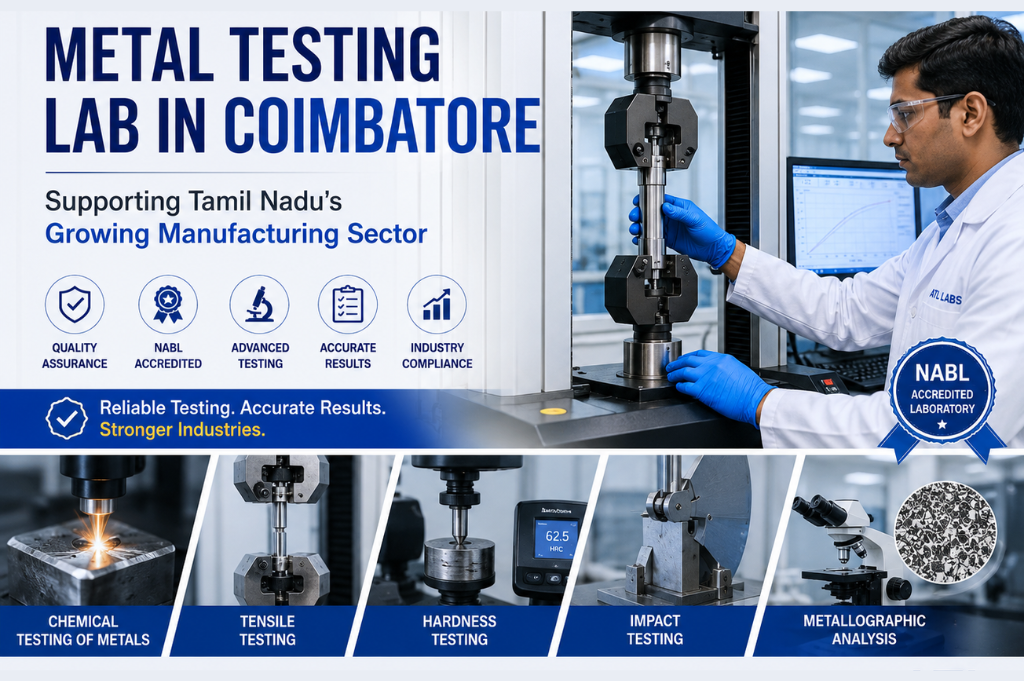
Metal Testing Lab in Coimbatore: Supporting Tamil Nadu’s Growing Manufacturing Sector Tamil Nadu has emerged as one of India’s strongest manufacturing hubs, contributing significantly to sectors such as automotive, engineering, aerospace, foundry, fabrication, and heavy machinery. As industries continue to expand, ensuring the quality, safety, and reliability of metal components has become more important than ever. A trusted metal testing lab in Coimbatore plays a vital role in helping manufacturers meet quality standards, regulatory requirements, and customer expectations. From raw material verification to final product validation, metal testing helps businesses reduce failures, improve performance, and maintain compliance. Why Metal Testing is Essential for Modern Manufacturing Metal components are the backbone of countless industrial applications. Any variation in composition, strength, hardness, or structural integrity can result in product failures, safety risks, and costly recalls. Manufacturers depend on professional testing services to: Verify raw material quality Ensure compliance with industry standards Improve product durability Detect material defects early Reduce production risks Meet customer and export requirements As manufacturing demand increases across Tamil Nadu, the need for a reliable metal testing lab in Coimbatore continues to grow. The Role of a Metal Testing Lab in Coimbatore A professional testing laboratory provides scientific analysis and validation of metallic materials used across industries. Material Verification and Quality Assurance Before metals are used in production, testing confirms whether the material meets required specifications. This helps manufacturers avoid quality issues and maintain consistency. Failure Analysis and Troubleshooting When components fail unexpectedly, laboratory testing identifies the root cause. This enables manufacturers to improve designs, processes, and material selection. Compliance with Industry Standards Testing laboratories help industries comply with national and international standards, including ASTM, ISO, BIS, and customer-specific requirements. Chemical Testing of Metals: Ensuring Material Integrity One of the most critical services offered by a metal testing lab in Coimbatore is Chemical Testing of Metals. Chemical analysis determines the elemental composition of a metal sample and verifies whether it meets specified standards. Why Chemical Testing of Metals Matters Chemical composition directly impacts: Corrosion resistance Strength and durability Weldability Machinability Product lifespan Even small variations in alloy composition can affect product performance significantly. Industries That Benefit from Chemical Testing of Metals Automotive manufacturing Foundries Aerospace engineering Construction industries Heavy equipment manufacturers Fabrication units Export-oriented industries Accurate Chemical Testing of Metals helps businesses maintain product quality while reducing production risks. Mechanical Testing Services for Manufacturing Industries Mechanical testing evaluates how materials perform under different conditions and loads. A NABL Accredited Mechanical Testing Lab in Coimbatore provides reliable data for assessing material strength and performance. Common Mechanical Tests Tensile Testing Measures a material’s ability to withstand pulling forces and determines ultimate tensile strength. Hardness Testing Evaluates resistance to wear, deformation, and indentation. Impact Testing Determines the toughness of materials under sudden loading conditions. Bend Testing Assesses flexibility and structural integrity. These tests help manufacturers select suitable materials for specific applications. Why Choose a NABL Accredited Mechanical Testing Lab in Coimbatore? Accreditation is a key indicator of technical competence and testing reliability. A NABL Accredited Mechanical Testing Lab in Coimbatore follows internationally recognized quality systems and testing procedures. Benefits of NABL Accreditation Accurate and traceable results Standardized testing procedures Greater customer confidence Improved regulatory compliance Recognition by government and private organizations Choosing an accredited laboratory ensures that testing results are reliable and accepted by customers and regulatory authorities. Supporting Tamil Nadu’s Expanding Industrial Ecosystem Tamil Nadu is home to thousands of manufacturing units ranging from MSMEs to multinational corporations. A trusted metal testing lab in Coimbatore supports this ecosystem by helping industries: Improve product quality Enhance process efficiency Reduce manufacturing defects Meet export requirements Strengthen supply chain reliability With increasing emphasis on quality assurance and global competitiveness, professional metal testing services have become indispensable for modern manufacturing. How Analytical Technology Laboratory Supports Manufacturing Industries Analytical Technology Laboratory provides comprehensive metal testing solutions for industries across Tamil Nadu. Our laboratory supports manufacturers with: Chemical Testing of Metals Mechanical Testing Services Material Analysis Quality Verification Failure Analysis Support Compliance Testing By delivering accurate and dependable testing results, Analytical Technology Laboratory helps businesses make informed decisions and maintain high-quality production standards. Learn more about our testing services: Analytical Technology Laboratory Why Analytical Technology Laboratory is Considered Among the Best Metal Testing Laboratory Options When selecting the Best Metal Testing Laboratory, manufacturers should look for: Technical expertise Advanced testing capabilities Industry experience Quality assurance systems Fast turnaround times Reliable customer support Analytical Technology Laboratory focuses on delivering precise testing solutions that help industries improve quality, safety, and operational efficiency. Conclusion As Tamil Nadu’s manufacturing sector continues to grow, the demand for accurate material testing is increasing rapidly. A trusted metal testing lab in Coimbatore plays a crucial role in ensuring product quality, compliance, and long-term reliability. Whether you require Chemical Testing of Metals, material verification, or services from a NABL Accredited Mechanical Testing Lab in Coimbatore, professional testing can help your organization achieve higher quality standards and stronger market credibility. Contact Analytical Technology Laboratory Today Need reliable metal testing services for your manufacturing business? Call Now: +91 95008 95001 Get accurate, reliable, and industry-compliant metal testing solutions from Analytical Technology Laboratory Get Enquiry
