FSSAI’s Action on “100% Pure” Claims: Understanding the Risks of Misleading Food Labels
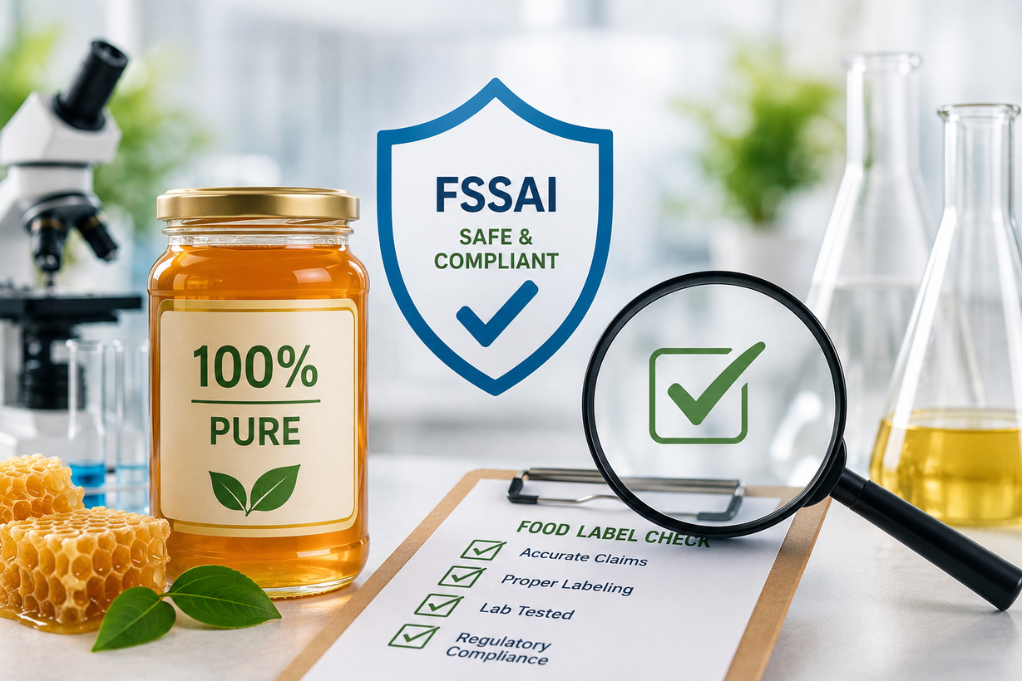
Consumer trust begins with honest product labeling. Whether it is honey, fruit juice, edible oil, dairy products, spices, or packaged foods, labels must accurately represent what consumers are buying.
Recently, FSSAI directed action against products marketed with the claim “100% Pure”, raising concerns that the wording could mislead consumers if it is not fully supported by product composition and regulatory requirements.
Although the case focuses on one manufacturer, it serves as an important reminder for every food and beverage business in India to review their labeling practices, product claims, and quality assurance processes.
Source URL: ‘100% pure’? Stop misleading products’ sale, FSSAI tells Dabur
What Is the Problem?
The main concern is the use of the phrase “100% Pure” on food products.
According to FSSAI, such claims may be considered misleading if:
- They create a false impression about the product.
- The claim cannot be scientifically verified.
- It suggests superiority over similar products without evidence.
- Consumers may interpret the wording differently from the actual product composition.
- The labeling does not fully comply with FSSAI regulations.
Food labels must provide accurate, truthful, and verifiable information without exaggerating product qualities.
Why Is FSSAI Concerned?
FSSAI’s role is to protect consumers by ensuring that food labels are transparent and not misleading.
The regulator expects manufacturers to:
- Use accurate product descriptions.
- Declare ingredients correctly.
- Avoid exaggerated marketing claims.
- Support claims with scientific evidence.
- Follow Food Safety and Standards (Labelling and Display) Regulations.
This helps consumers make informed purchasing decisions based on reliable information.
Reasons Why Products Face Regulatory Action
Food businesses may receive regulatory notices for several reasons, including:
1. Unsupported Product Claims
Claims such as 100% Pure, Natural, Chemical-Free, or No Preservatives should be backed by evidence.
2. Incorrect Labeling
Missing or inaccurate ingredient declarations, nutritional information, or mandatory labeling details can result in non-compliance.
3. Lack of Scientific Validation
Without laboratory testing, businesses may struggle to justify marketing claims during inspections.
4. Failure to Follow Updated Regulations
Food regulations are periodically updated, making it essential for businesses to review labels regularly.
5. Consumer Protection
FSSAI prioritizes preventing misleading information that could influence consumer purchasing decisions unfairly.
Business Risks of Misleading Claims
Using unsupported or misleading claims can lead to:
- FSSAI notices
- Product recalls or withdrawal
- Financial losses
- Brand reputation damage
- Consumer complaints
- Increased regulatory inspections
- Reduced customer confidence
For manufacturers, prevention is far less costly than corrective action.
How Laboratory Testing Helps?
Independent laboratory testing provides scientific evidence to support product quality and labeling.
Testing can verify:
- Ingredient composition
- Product purity
- Nutritional values
- Chemical parameters
- Microbiological safety
- Heavy metals
- Pesticide residues
- Adulteration
- Product consistency
These reports help businesses demonstrate compliance with regulatory requirements.
Why NABL-Accredited Testing Matters
Choosing a NABL-accredited laboratory ensures:
- Accurate and reliable results
- Validated testing methods
- Qualified technical experts
- Internationally accepted quality standards
- Stronger regulatory confidence
- Better support during audits
How ATL Labs Supports Food Businesses
ATL Labs provides comprehensive food testing solutions to help manufacturers meet FSSAI requirements and maintain consumer trust.
Our services include:
- Chemical Analysis
- Microbiological Testing
- Nutritional Analysis
- Food Adulteration Testing
- Heavy Metal Analysis
- Pesticide Residue Testing
- Shelf-Life Studies
- Water Testing
- Packaging Material Testing
- Regulatory Support Testing
Our NABL-accredited laboratory helps businesses validate product quality, support labeling claims, and strengthen compliance with Indian food safety regulations.
Best Practices for Manufacturers
To reduce compliance risks:
- Review all product labels before launch.
- Validate marketing claims with laboratory evidence.
- Conduct routine product testing.
- Maintain detailed quality documentation.
- Stay updated with FSSAI regulations.
- Perform periodic internal audits.
- Work with NABL-accredited laboratories.
Conclusion
The recent discussion around “100% Pure” claims highlights the importance of truthful labeling and scientific validation in today’s food industry.
As regulatory oversight continues to strengthen, food manufacturers must ensure that every claim on their packaging is accurate, evidence-based, and compliant with FSSAI requirements.
By partnering with a trusted NABL-accredited laboratory like ATL Labs, businesses can confidently verify product quality, support compliance, and build long-term consumer trust.
Ensure Your Product Claims Stand Up to Regulatory Scrutiny
Whether you’re launching a new food product, updating packaging, or validating quality claims, ATL Labs provides accurate, NABL-accredited food testing services to help you meet FSSAI standards with confidence.
Contact ATL Labs today to safeguard your brand through reliable food testing and regulatory compliance.
Disclaimer:
This content is based on publicly available news reports and is for informational purposes only. Analytical Technology Laboratory has not independently verified the reported incident.
